Lead Curator and Sceneographer, London College of Fashion, UAL, 2023–24

As curator of Designed for Life, Dr Leila Nassereldein worked directly with Professor Helen Storey to translate a substantial body of work arising from Za’atari Refugee Camp into a public exhibition across two galleries at London College of Fashion’s East Bank campus. Storey was named Za’atari’s first Artist in Residence and later worked as UNHCR’s first Designer in Residence at the camp, developing projects with women and girls through fashion, making, livelihood creation and reciprocal exchange.
The curatorial challenge was not simply one of selection, it was how to exhibit work formed under the conditions of forced displacement without aestheticising suffering or reducing its makers to humanitarian evidence. Nassereldein adopted a restrained scenographic language, allowing material provenance, collaboration and political context to remain legible without overwhelming the works with interpretation.
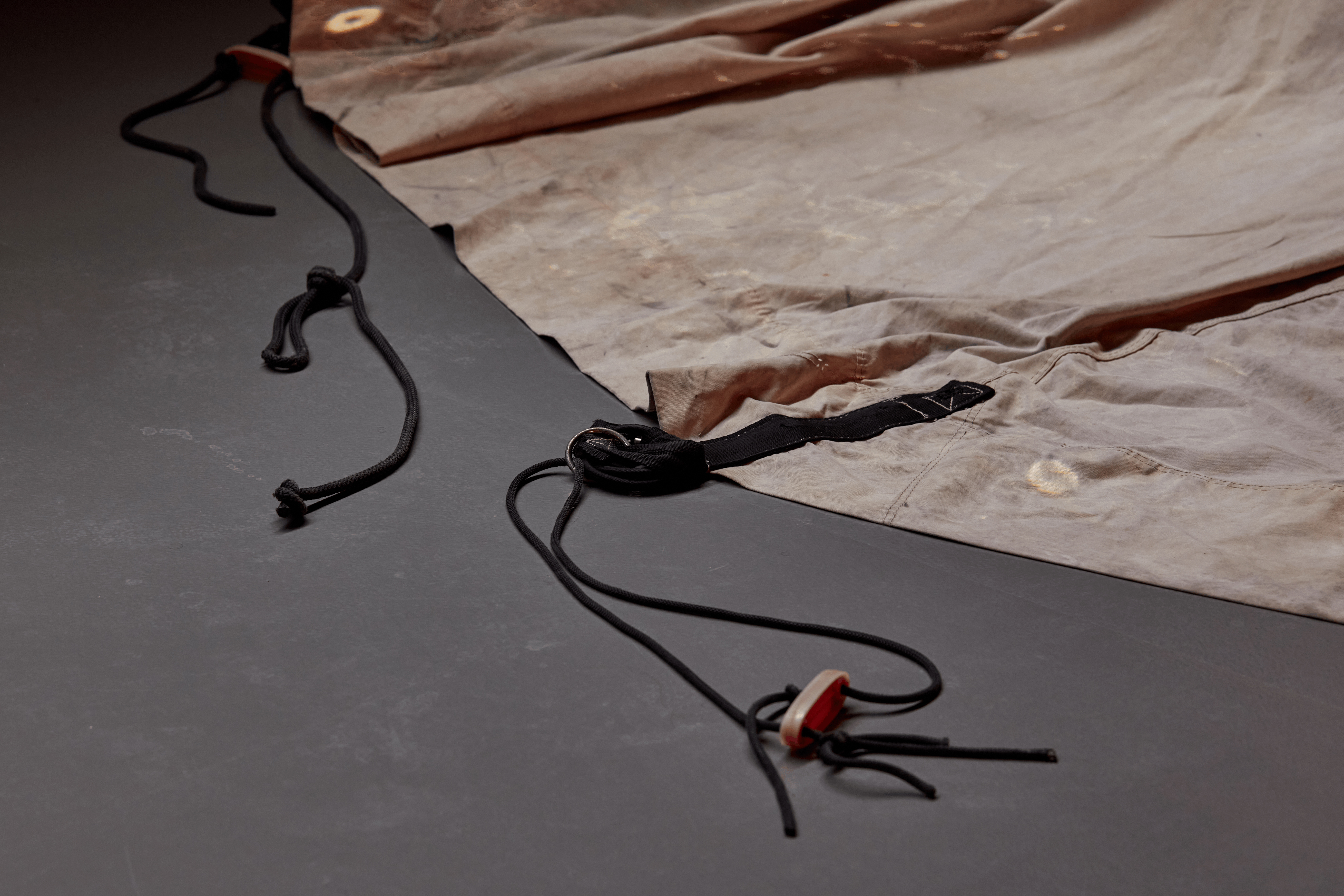
At the centre of the presentation was Storey’s Dress for Our Time, constructed from a decommissioned UNHCR tent that had once housed a displaced Syrian family in Jordan. Nassereldein had the gallery windows completely blacked out, removing daylight and the visual interference of the surrounding building. In the resulting darkness, the dress appeared simultaneously as garment, former shelter and projection surface: an absent body invoked through material that had once protected other bodies.
Working with Holition, Nassereldein directed the installation of the data projection. Each pixel of light represented 100 human lives; rising from the hem, the lights travelled from six points representing the continents people had fled before populating the countries in which they found shelter. The accompanying interpretation situated the work within UNHCR’s 2016 Global Trends data, which recorded nearly 21.3 million refugees worldwide during the preceding reporting period.
The projection did more than illustrate a statistic. It set numerical abstraction in motion across a material already marked by displacement. Data became light; shelter became image; the global scale of forced movement passed across the intimate dimensions of a dress. The scenography held visual wonder in tension with the violence to which the work referred, without allowing one to cancel the other. Holition describes the projection as a data visualisation in which individual points of light represented human movement recorded through UNHCR statistics.
Nassereldein placed Dress for Our Time in relation to Jacket of Wishes, LOVECOATS, Messages of Hope and embroidered backgammon boards produced through Storey’s work at Za’atari. Made from remaining tent fabric, Jacket of Wishes carried messages written in Arabic by women in the camp, with their English translations inscribed inside. LOVECOATS emerged from conversations with the TIGER girls around warmth, fashion, making and gift-giving: each participant made a coat for herself and another for someone she loved.
Together, these works moved between shelter, inscription, warmth, exchange and play. They resisted a singular account of displacement by foregrounding skill, authorship and cultural life while keeping the coercive circumstances of their production in view. An independent review of the exhibition similarly described the darkened gallery as holding enigmatic beauty together with the traces of extreme suffering.
The embroidered backgammon boards extended this argument from object into use. Made by Syrian women, they carried memories of gardens, flowers and domestic life in Syria into a portable social form whose significance depends upon gathering around it. Nassereldein activated their inclusion through a free Levantine community evening of backgammon, Syrian food, Arabic coffee, fresh mint tea, dates and music. Friends, families and new acquaintances occupied the gallery together, returning the boards to the convivial relations for which they had been made.
Held amid acute political grief across Palestine and the continuing effects of war and displacement in Syria, the event created room for difficult realities to be approached through play, hospitality and shared time. Joy did not soften the exhibition’s politics, but it asserted the persistence of social and cultural life within a geopolitical landscape structured by violence and loss.
Across the two galleries, Nassereldein moved between concentration and activation: darkness and minimalism where the work required sustained attention; communal occupation where meaning depended upon use. Her curatorial authorship lay in making Storey’s Za’atari practice public without reducing it either to an iconic dress or a narrative of humanitarian uplift; the exhibition disclosed a wider ecology of shelter, data, memory, co-creation and material survival.



You must be logged in to post a comment.