Creative Director, Curator, Producer and Community Programme Developer: Dr Leila Nassereldein
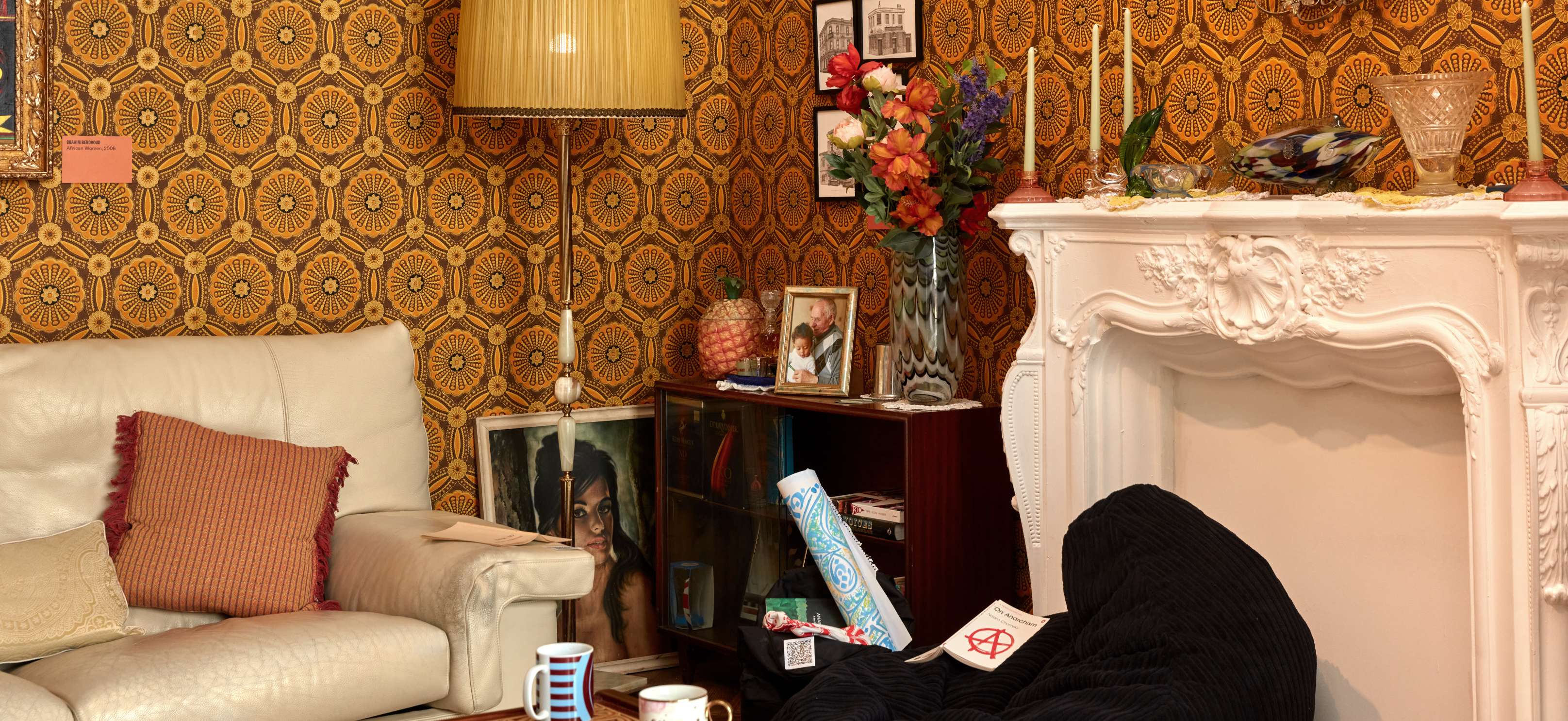
Nana’s House was conceived, produced and curated by Dr Leila Nassereldein as an immersive installation exploring the everyday histories of east London through the domestic space of the living room.
Nassereldein initiated the project through an open call, recruiting four community co-curators – Pallavi Chamarty, Omolara Obanishola, Dave Sohanpal and Anh Tran – and designed and led a six-week Community Curator Summer School. Through collective reading, archival research, community interviews, oral-history gathering, object-based enquiry and spatial experimentation, the group considered how migration, labour, protest, fashion, music, housing and family memory might be given material form.
Dr Michael McMillan, whose work on the Caribbean front room has transformed understandings of the domestic interior as a site of cultural memory, supported the project.
The resulting installation took the form of an inhabited, semi-fictional family home. Furniture, clothing, textiles, records, photographs, books, artworks and domestic objects were assembled into a living room that visitors could enter and spend time within. Commissioned works by Sahira Khan, Shama Kun, Tae Ateh and Poppy Frean appeared alongside loans, films and contributions from artists and community collaborators.
The community interviews became the basis of the installation’s sonic life. Memories and oral histories were reworked into a conversation between the house’s semi-fictional characters, heard chatting together as though at a Sunday family gathering. Visitors were invited to sit within the living room and listen as each voice opened onto a different aspect of east London’s precarious past: migration and displacement, industrial and domestic labour, political protest, changing neighbourhoods, housing insecurity, aspiration and survival.
Rather than presenting these histories as separate testimonies, the soundscape allowed them to overlap, interrupt and answer one another. Historical knowledge emerged through the rhythms of ordinary conversation – through anecdote, disagreement, recollection and the intimacy of voices sharing a room. The domestic gathering became a way of holding multiple histories together without reducing them to a single representative account.
Nassereldein developed the project as a form of spatial historiography. The living room was not treated as neutral décor or nostalgic reconstruction, but as an archive produced through use: a place where histories are carried by furniture, gesture, sound and repeated domestic practice. Objects were arranged as a three-dimensional constellation, allowing different lives and temporalities to meet across the room.
By placing oral history, community knowledge and domestic material culture at the centre of the gallery, Nana’s House shifted historical authority away from the display case and towards inhabitation, memory and collective interpretation. The installation asked how an institution might encounter local histories not as content to be extracted, but as living relations requiring time, reciprocity and shared authorship.